Share This!
Welcome back, Books After Dark fam—it’s your boy Mr. Steve! Today we’ve got some money-making news that might raise eyebrows for a whole different reason: AI isn’t just testing the waters—it’s already reshaping the job market.
According to a recent Microsoft report (as covered by MSN, Forbes, and other outlets), as many as 40 job types are at high risk of automation. That sounds scary, yes, but we’re not trying to scare you, but definitely give you a heads up!
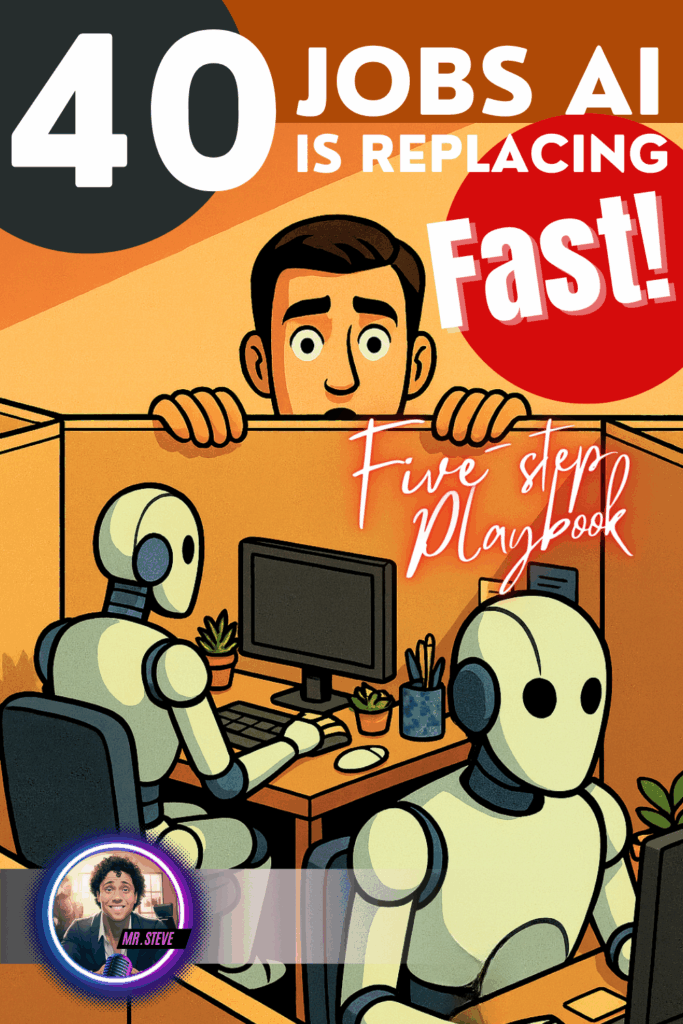
In this post, we’ll break down the 40 jobs AI is replacing fast and group them into 7 easy-to-understand job sectors. We’ll also share 5 steps to future-proof your career so you can stay ahead. Because in 2025, having the right credentials doesn’t guarantee job security anymore. Even careers once seen as “safe,” like financial advisors or business analysts, are now feeling the pressure from AI.
However, the good news, AI tools still have limits, so let’s dive into it.
👉 Disclaimer: This post is for educational and entertainment purposes only. It’s not financial or career advice. I’m simply breaking down what reputable sources are reporting and offering ideas to help you think ahead.
The Claim & Receipts (40 Jobs AI Is Replacing Fast, Condensed by Sector)
Microsoft’s analysis—echoed by MSN—suggests that automation could impact about 40 distinct roles.
Rather than list every job title, let’s group them into 7 key sectors below.
1. Clerical & Administrative
Data-focused + repetitive office roles:
- Brokerage Clerks
- New Accounts Clerks
- Statistical Assistants
- Switchboard Operators
- Telephone Operators
- Ticket Agents & Travel Clerks
2. Customer Service & Support
Frontline interaction roles:
- Customer Service Representatives
- Public Safety Telecommunicators
- Telemarketers
- Concierges
- Hosts & Hostesses
- Counter & Rental Clerks
- Passenger Attendants
3. Retail & Sales
Direct selling, promotions, and account-building:
- Sales Representatives of Services
- Advertising Sales Agents
- Demonstrators & Product Promoters
- Models
4. Media, Writing & Communications
Content creation and information roles:
- Writers & Authors
- Technical Writers
- Proofreaders & Copy Markers
- Editors
- News Analysts, Reporters & Journalists
- Broadcast Announcers & Radio DJs
- Public Relations Specialists
5. Education & Academia
Teaching and knowledge-transfer roles:
- Farm & Home Management Educators
- Business Teachers (Postsecondary)
- Economics Teachers (Postsecondary)
- Library Science Teachers (Postsecondary)
6. Research & Analysis
Data, strategy, and professional knowledge workers:
- Data Scientists
- Market Research Analysts
- Management Analysts
- Personal Financial Advisors
- Political Scientists
- Mathematicians
- Geographers
- Historians
- Archivists
7. Tech & Development
Roles that design, build, and program technology:
- Web Developers
- Manufacturing Tool Programmers
Each of these areas shares a common thread: much of the work can be standardized and handed off to algorithms, robotics, or AI scheduling tools.
For Microsoft’s complete list — including the 40 Jobs Least Impacted by AI — click here.
5 Steps to Future-Proof Your Career (Your Starter Roadmap & Playbook!)
You’ve seen the list of jobs at risk — now let’s shift gears. This isn’t about panic, it’s about preparation. Here’s a simple 5-step starter roadmap you can use to stay one step ahead of AI and protect your future income.
Step 1: Network
Most of the jobs on this list won’t disappear completely — but the number of workers needed will shrink. AI will handle more of the repetitive stuff, but human hands and eyes will still be required. That’s where your network comes in. When jobs are scarce but still out there in your field, who you know can be the difference between staying employed or getting left out.
👉 Steve’s Pro-Tip: Networking won’t “save” every job, but it will give people a leg up when roles exist but are harder to secure.
Step 2: Re-skill with AI-Proof Skills
Take courses and earn certifications that build on creative problem-solving, complex analytics, people-driven leadership — and yes, AI learning that gives you a competitive edge in your field.
👉 Steve’s Pro-Tip: Free starting points include Coursera, edX, and LinkedIn Learning. And this just in! OpenAI has committed to certifying 10 million Americans by 2030 through the OpenAI Academy.
You can start right now by using ChatGPT’s study mode to learn, practice, and even build a portfolio of real AI-driven projects.
Sources & Links to Learn More:
OpenAI’s Commitment to Certify 10M Americans
- OpenAI Blog
- Forbes: OpenAI, Cisco, And The White House Race To Close The AI Skills Gap
- Benzinga: OpenAI To Certify 10 Million Americans In Generative AI By 2030
ChatGPT “Study Mode” Details:
Step 3: Invest Like an Owner
Instead of fearing AI and automation, own a piece of it. Think dividend-paying companies and everyday staples that thrive in any economy — steady, dividend-rich businesses can keep paying you whether or not you’re working.
👉 Steve’s Pro Tip #1: Start with companies that have a long history of paying dividends and growing them steadily. Think trusted staples like utilities, consumer goods, and big brands that people always need.
Beginner Resources:
- Forbes: Dividend Investing for Beginners in 4 Simple Steps — easy guide to get started.
- How to Invest in Dividend Stocks: A Beginner’s Guide (Stash) — practical tips & concepts every beginner should know.
- 5 Dividend Stocks With Exposure To The AI Boom (Sure Dividend) — includes IBM, Qualcomm, Broadcom, OpenText, and Accenture.
- These Top-Ranked AI Stocks Pay Dividends (Nasdaq) — mentions Broadcom, Vertiv, and others.
👉 Steve’s Pro Tip #2: Dividend yields from AI-focused companies are often lower than traditional income stocks, since many reinvest heavily in growth. That means returns can take longer. As always, seek out a trained professional for financial advice — whether that’s a Certified Financial Planner (CFP®), an SEC-registered investment advisor, or a trusted brokerage like Fidelity, Vanguard, or Schwab.
Step 4: Start a Low-Overhead Digital Venture
Print-on-demand, blogs with affiliate income, and digital guides that add value are less automation-vulnerable and can be a quick, steady flow of income — while also showcasing your expertise.
👉 Steve’s Pro Tip: Here are a couple of resources to help you get started:
These kinds of ventures don’t require a big upfront investment, which makes them a smart starting point for beginners.
Step 5: Build Multiple Income Streams
Mix part-time consulting, dividend stocks, and small digital products so one job loss doesn’t crash your finances.
👉 Steve’s Pro Tip: Think of it as your safety net — the more streams you build, the harder it is for AI (or anything else) to knock you completely off course.
Final Word
AI isn’t coming — it’s already here. Now you have a step-by-step playbook to help you navigate in the light and not in the dark. These steps may seem mundane and not a magic cure, but they are the keys to keeping a steady flow of income in an ever-changing and uncertain environment.
Each step, even Steps 1 and 5, might sound easy to do or even be lumped into the same category — but they’re separated to help you focus, because there is a difference between who you know vs. what you do. Each step deserves the same amount of quality focus and attention to grow.
Bookmark this guide and come back to it as you build your roadmap.
What's Next?
Want to know how Harlan Rappaport, 27, made $833,000 on the freelance platform Fiverr — first as a side gig and now full-time?
Harlan shared his story with Business Insider, and they even verified his earnings with documentation.
📌 Click here to read: “Fiverr Success Story: How I Turned a Side Hustle Into $800,000 in 5 Years” (Link is not live yet.)
And don’t forget to subscribe to the Mr. Steve YouTube channel for more investigations like this. We keep it real, we keep it fresh, and we keep you hustling smart.
You can also join the Books After Dark family on Facebook to stay in the loop and so we can stay connected.
And if you’re ready to explore even more money-making opportunities, click here or check out the latest video on the Mr. Steve Official YouTube channel below.
Author
-
Once upon a time, in a land of mystery and darkness, there was a man named Mr. Steve. He wasn't just any ordinary man, though. He founded Books After Dark, a platform for all things dark, mysterious, and self-publishing. Mr. Steve was a man of many talents. He was a contributing writer, graphic designer, and video creator. He had even ventured into the world of self-publishing, selling thousands of his books worldwide. Despite his success, Mr. Steve didn't want to keep all the secrets of self-publishing to himself. He wanted to provide education on self-publishing, affiliate marketing, and other online money-making opportunities. So thus, Books After Dark was born to help other aspiring authors and artists find success in the online world. In recent times, Mr. Steve has even delved into the world of low-content books, and he's excited to share his journey with others on the "Make Money Online with Books After Dark" YouTube channel. While he currently doesn't sell or promote his book titles through Books After Dark, who knows what the future holds? Mr. Steve is always up for a good mystery, and there's no telling what dark and mysterious tale he might come up with next.
View all posts